
|
| The Albion men's basketball team joins in a moment of silence for their late teammate Zachary Winston on Nov. 22, 2019. Winston died via suicide on Nov. 9 of that year. By Nick Buckley/Battle Creek Enquirer, via Imagn Content Services, LLC |
By Ryan Scott
D3hoops.com
Albion doesn’t have everyone it expected to have on the roster this year. Like many Division III programs across the country, whether through COVID complications or the natural movement of players, Jody May’s Britons are missing several key cogs, including Jamezell Davis, Jr, one of the stars of last season’s 21-5 squad that narrowly missed the NCAA Tournament after a heartbreaking four-point loss to Trine in the MIAA semifinals.

|
| Zach Winston's jersey, draped over a chair at a November 2019 home game. This year, Zach's younger brother, Khy, has taken the number. By Nick Buckley/Battle Creek Enquirer, via Imagn Content Services, LLC |
Albion was poised to be a national contender in 2020-21 and then there was no NCAA Tournament to contend for. The most glaring absence, though – the disappointment that remains present every day – is that Zach Winston isn’t here to battle alongside them. Winston, a sophomore guard and already a team and campus leader, died by suicide on Nov. 9, 2019, just a day after last season’s opening game.
In a year with so much lost to COVID, just getting on the floor and playing a game is a victory. Nobody knows the truth of that more than Albion. “How was I even supposed to coach after [losing Zach]?” May asked himself. “We had to learn that getting through something doesn’t mean you forget.”
Albion traveled to Ohio the next weekend, as planned, and came home with two wins.
“It wasn’t over after that weekend,” says May. “We had to let things out and be there for each other – it keeps coming up.” Mental health has increasingly become a focus for coaches and athletic teams; what was once almost taboo is now an everyday conversation. “The biggest difference from when I was playing,” adds May, “is how important it is to establish a personal relationship with each player; they have to be able to talk to you when things are tough.”
We must also remember, though, that talking is not always enough. Serious mental health issues and illness require professional medical care. May notes that most of the faculty and staff at Albion have been through mental health first aid training, but like CPR or physical first aid, these are just basic skills necessary to manage a situation until the professionals can show up.
“I’ve learned so much about mental health in the last year,” says May. “There’s still so much unknown about mental illness; just because someone is getting help, doesn’t mean they’re getting the right help and there’s such a lack of resources and trained professionals to help everyone who needs it. We have to do better as a society.”
The US Substance Abuse and Mental Health Services Administration, a branch of the Federal Department of Health and Human Services tasked with improving the quality and availability of services for people dealing with complications of mental illness, estimates that by 2025 the U.S. will face shortages of 30,000 therapists and mental health counselors, 50,000 psychologists and psychiatrists, and 125,000 social workers and school counselors.
Winston’s brother, Cassius, then a star basketball player for Michigan State, revealed Zach’s battle with mental health issues and spoke about the family’s efforts to support him. “You can do everything and still wonder what more you could’ve done,” notes May, who credits open and honest conversation with helping himself and his team to persevere.
“We were 100% more (mentally) prepared for COVID because of last season,” says May. “A lot of teams have been through a lot this year; we, specifically, have been through more.” Getting a chance to play basketball, to get on the court, may be a welcome reprieve from the stress of disruption and pandemic, but it’s not a solution to mental illness.
“We don’t want to talk much about how Zach died,” says May, “because we want to remember how he lived – he was a great leader and a great person – but we’re doing everyone a disservice if we don’t talk about suicide and mental illness, because maybe we can help someone else before they get to that point. It can be uncomfortable, but you have to have tough conversations and you can’t be afraid.”
|
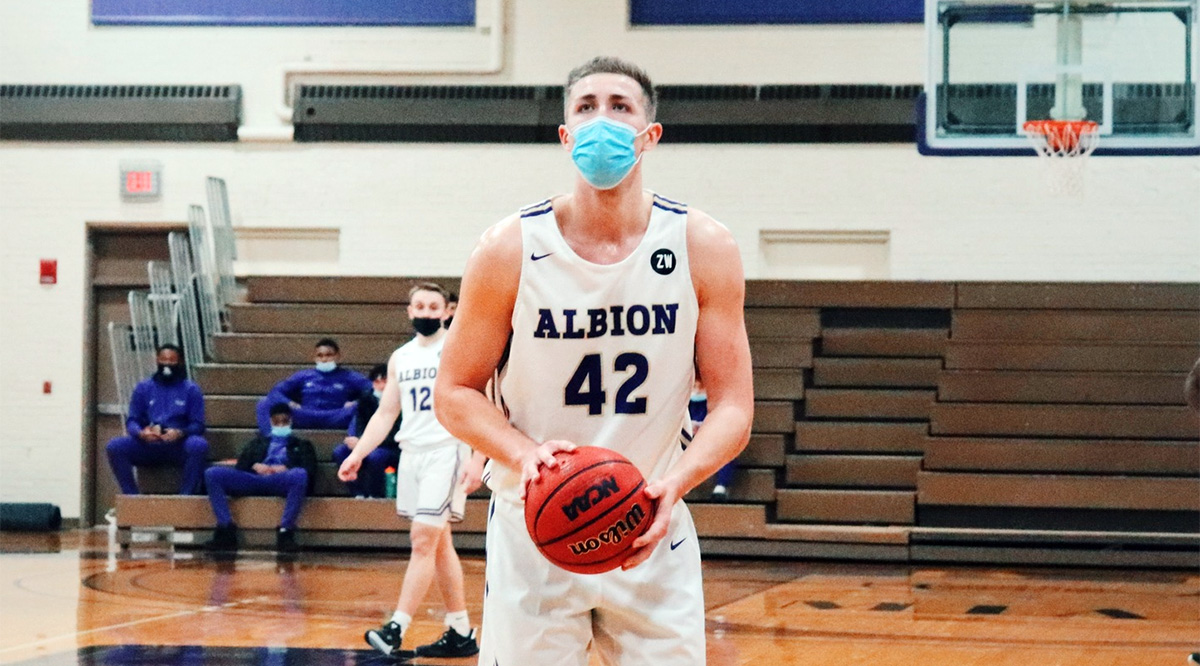
| The team continues to wear a patch in remembrance of Zach Winston, as Caden Ebeling does here in a game from February. Albion athletics photo |
Communication and individual attention is key. “Within any group you will have a variety of responses to trauma,” says St. Thomas coach John Tauer, who’s also a professor of psychology, teaching courses on motivation and emotion – and, as he’s quick to point out, not a clinical psychologist, nor an expert on stress and trauma, “There is a continuum of response to stressors, like COVID; different groups of players will respond differently.”
If you need help ...If you need help, please talk to someone. Here are some resources to call, text or tweet:
|
Tauer’s approach to COVID was lots of information, noting “unpredictable stressors are much more difficult than predictable ones; we try to let our players know what we’re providing for them during this time, what our goals are, and to be up front about just how much has changed, even for coaches.” He notes that pretending everything is normal can often be harmful when it’s clear to everyone that things aren’t normal. St. Thomas cut back on Zoom meetings, for example, when it became apparent they were more of a reminder of what was different than a way of keeping things the same.
As for Albion, they don’t really need a national championship to keep them motivated. At 8-3 on the year, things are going well on the court. They dropped a five point game to Hope (later avenged) and two to nationally ranked Trine, but none of the others have been very close. Junior Cortez Garland has doubled his scoring output from last season, making up for a lot of Davis’ production, and senior Caden Ebeling continues to be a solid presence down low – both players are averaging right around 20 points per game.
It’s not the national title chase Albion had on tap for last year or this season, but for May, seeing his team succeed in the midst of upheaval and tragedy has been the real victory. “It’s been a hard, hard thing for these kids to go through, but we went through it together and it’s been an unbelievable experience.”
