|
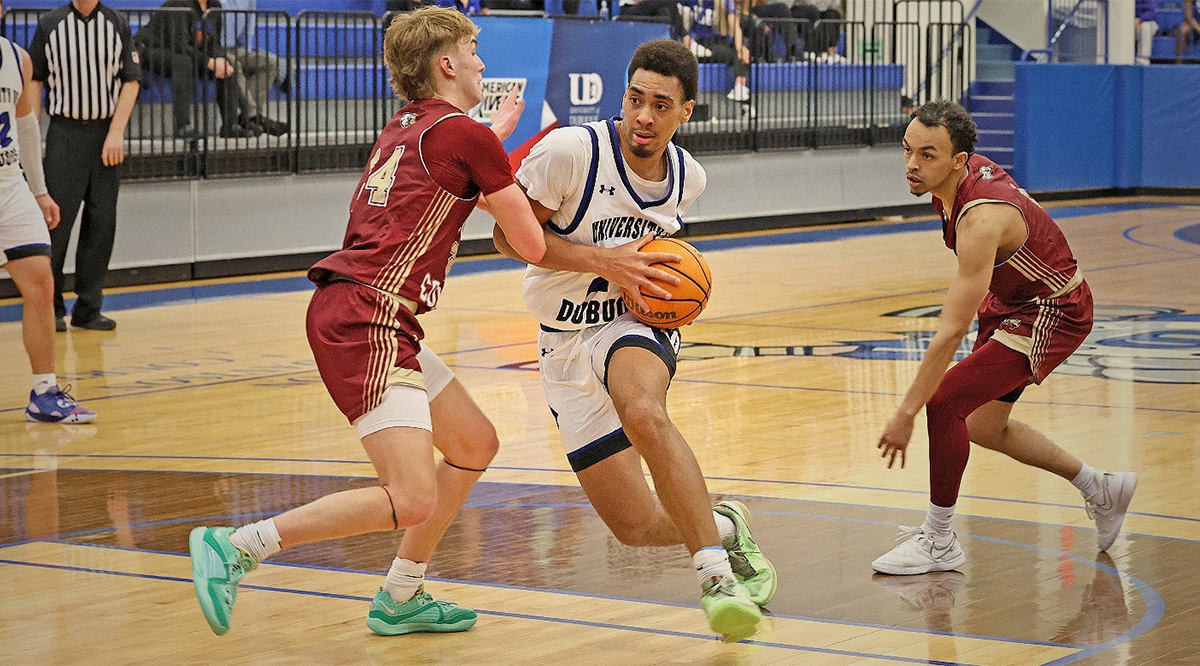
| Will either Coe or Dubuque make our projected field? Dubuque athletics photo by Paul Misner |
By Pat Coleman
D3sports.com
The Division III basketball analytics universe is this whole cottage industry these days, and it has certainly made Selection Sunday a lot more fun, a lot more interesting, and possibly a little more accurate. There is a whole group of people who study the regional rankings, the criteria, and bring their knowledge to the table.
That group has been great, and we did it again Sunday night, as our mock committee was as follows: Matt Snyder helped with his indispensible strength-of-schedule work, and Bob Quillman and Ryan Scott formed the rest of our committee, with Dave McHugh, on Hoopsville.
And, as usual, these picks do not influence the NCAA Tournament selection committee's picks, nor does our Top 25 poll. No national Top 25 is ever considered in an NCAA selection process.
Here are our projections.
- NCAA Selection Show broadcast at 1 p.m. ET
- Who's in automatically: 42 conference winners
- NCAA Tournament FAQs
We start by projecting the regional rankings for each of the 10 regions because that's how the process actually starts. The regional committees that have been producing those rankings do it one more time and then send them to the national tournament selection committee. That committee may make adjustments to the regional rankings, which can alter which teams are regionally ranked, which then changes some teams' records against regionally ranked opponents (one of the criteria in selecting at-large teams).
The updated regional rankings are a D3Datacast exclusive production.
Eventually the national committee ends up with a final list of regional rankings, which they will announce after the brackets are released. The rankings include teams which have clinched automatic bids, which are set aside for the bracketing stage. Then the highest ranked team without an automatic bid within each region comes to the table for consideration as an at-large candidate. There are 10 teams up for consideration at any point, one from each region. When a team is picked, the next highest ranked team within that region comes to the proverbial table.
Our committee's job is to pick 22 at-large teams, and then Ryan Scott and I bracket them after all the teams are chosen.
We knew there were a number of obvious picks who were going to make the NCAA Tournament, no matter what, especially when Randolph-Macon is in the at-large pool, not to mention Widener and NYU and Trine. So we start with Randolph-Macon, Widener, New York University, Trinity (Texas), Oswego State, Washington U., Trine, Cal Lutheran and Guilford.
At that point, we had exhausted the obvious ones, the teams who were on the top of the at-large list from everyone on our panel. Here's how the table looked at this point, with the 10 teams actually being considered, with listings of the three numerical categories of D-III winning percentage, D-III strength of schedule, record against regionally ranked opponents:
Region 1: Tufts, .731, .578, 5-5
Region 2: Nichols, .833, .532, 1-2
Region 3: St. Lawrence, .692, .557, 3-5
Region 4: Rowan, .731, .594, 5-6
Region 5: Hood, .760, .573, 4-4
Region 6: Virginia Wesleyan, .692, .604, 5-6
Region 7: Calvin, .846, .554, 3-4
Region 8: Illinois Wesleyan, .704, .546, 5-4
Region 9: Nebraska Wesleyan, .852, .547, 4-4
Region 10: St. Thomas (Texas), .760, .522, 5-0
From this point, our committee clustered Hood, Tufts and Virginia Wesleyan together, and took all of them. The word is that a huge SOS like the one that Virginia Wesleyan has overcomes a winning percentage that is below .700. Hood is replaced on the board in Region 5 by Gettysburg, while Tufts is replaced by Williams in Region 1 and Virginia Wesleyan is replaced by Washington & Lee.
| Story continues below ... |
The committee took Williams next, with a .778 winning percentage, a .553 SOS and a 5-4 record against regionally ranked opponents. That includes a win against Trinity (Conn.) -- the only win against Trinity (Conn.) all season. And they put Connecticut College into the field in Region 1, rather than Albertus Magnus. Albertus defeated Conn head to head, but our group is firm in its belief that Conn should be ranked higher.
Up next, Nebraska Wesleyan, and Coe joined the board in Region 9. Calvin was taken at the 15th slot, and Carnegie Mellon came to the board in Region 7. Rowan, which has been on the board since the beginning, gets taken at the 16th spot.
We have six spots left. In round 17, the decision comes down to DeSales and Coe. DeSales has an .889 winning percentage, .537 SOS and 3-3 against regionally ranked opponents, while Coe is .808, .555 SOS and 4-3 vs. regionally ranked opponents. The team took Coe based on the strength of Coe's regionally ranked wins, with two wins against Loras.
Once Coe got in, Dubuque joined the board. DeSales went next because their winning percentage was so much higher than anyone else on the board, and their SOS is certainly reasonable, if not great.
We have four spots left. Stockton joins the board in Region 4, and they have just a .630 winning percentage, plus a .574 SOS. But Carnegie Mellon has a slightly better winning percentage, it has a .601 SOS, and a 6-6 record against regionally ranked opponents. And it's the quality of the wins for Carnegie, wins against Case Western Reserve, two wins against NYU and a win against Washington U. The crew took Carnegie Mellon.
That opens up another spot in Region 7, and coming to the board in the 7 is Mount Union, which has a .741 winning percentage, a .565 SOS and a 1-3 SOS.
Lurking still here at spot 20 is St. Thomas (Texas), which has been sitting here for some time with a .760 winning percentage, a .522 SOS and a 5-0 record against regionally ranked opponents. St. Thomas, or Dubuque, or Illinois Wesleyan ... or Connecticut College or Nichols, even. And the crew took the resume of St. Thomas (Texas), whose best regionally ranked wins are pretty good, two of them against Trinity, highly ranked in the 10.
That brings Pomona-Pitzer to the board, at .708/.560/1-6. That resume is not likely to play a role here down the stretch. At pick 21, we land on Dubuque. The Spartans are here with a .778 winning percentage, a .565 SOS, and a 3-5 record vs. regionally ranked teams. Dubuque is replaced by St. John's in Region 9, and SJU is .769/.526/2-2. St. John's has a win against Stockton, which is also on the board, and a loss to Mount Union, also on the board. That actually helps us out less than it might. That win is Mount Union's only regionally ranked win, and having just the one is tough for the Purple Raiders.
It's usually helpful to eliminate teams from consideration at this point, so we'll start with Gettysburg, which has the lowest SOS and one of the lowest winning percentages on the board. We also eliminate St. John's, and Washington & Lee. We end up eliminating Moutn Union as well, with just one regionally ranked win. Nichols also has just one RRO win, but has the highest winning percentage on the board and gets saved for now. We try to compare Illinois Wesleyan, Connecticut College and Nichols.
For Nichols, that regionally ranked win is against Western New England, ranked 5 in its region. Connecticut College has wins against a No. 2 in Tufts, and Amherst and RPI, which were both ranked last week but drop out this week. They count -- we look at them as ranked No. 8. Illinois Wesleyan's wins are against a No. 1 in Wash U., and a No. 2 in Elmhurst. Even if Carthage doesn't make the regional ranking, which the D3Datacast projection said they would, IWU still has great RRO wins, and that gets Illinois Wesleyan in the field.
Our projected 22 at-large bids go to, in order of selection: Randolph-Macon, Widener, New York University, Trinity (Texas), Oswego State, Washington U., Trine, Guilford, Cal Lutheran, Hood, Tufts, Virginia Wesleyan, Williams, Nebraska Wesleyan, Calvin, Rowan, Coe, DeSales, Carnegie Mellon, St. Thomas (Texas), Dubuque, Illinois Wesleyan.
Here's who was left on the board when IWU was selected 22nd.
| Region 1 | Connecticut College | NESCAC | .720 | .563 | 3-7 |
| Region 2 | Nichols | CCC | .833 | .532 | 1-2 |
| Region 3 | St. Lawrence | LL | .692 | .557 | 3-5 |
| Region 4 | Stockton | NJAC | .630 | .574 | 5-6 |
| Region 5 | Gettysburg | CC | .731 | .515 | 5-2 |
| Region 6 | Washington & Lee | ODAC | .643 | .590 | 3-8 |
| Region 7 | Mount Union | OAC | .741 | .565 | 1-3 |
| Region 8 | IWU was selected | ||||
| Region 9 | St. John's | MIAC | .769 | .526 | 2-2 |
| Region 10 | Pomona-Pitzer | SCIAC | .708 | .560 | 1-6 |
St. Norbert would have been next onto the board if we had had a 23rd round.
Here's how we would pair them up:
| Story continues below ... |
Each pod is set up the same, with teams "seeded" 1-4, and the host team playing the 4 in the first round. Teams which fly in the first weekend are noted with an asterisk.*
Top left quadrant
No. 1 overall seed Hampden-Sydney hosts Mary Baldwin, while Eastern plays Stevens
Catholic hosts Babson, while Virginia Wesleyan plays Utica
John Carroll hosts Wabash, while Hope plays Illinois Wesleyan
Trinity (Texas) hosts Texas-Dallas, while St. Thomas (Texas) plays Dubuque*
Bottom left quadrant
Case Western Reserve hosts Centenary (La.)*, while Calvin plays Wisconsin Lutheran
Trine hosts La Roche, while Coe plays Illinois College
UW-Platteville hosts Gustavus Adolphus, while Loras plays Bethany Lutheran
Washington U. hosts Fontbonne, while Nebraska Wesleyan plays Anderson
Top right quadrant
Widener hosts Baruch, while Williams plays Carnegie Mellon
Guilford hosts Berry, while Rowan plays Geneva
New York University hosts Husson, while Christopher Newport plays Hobart
Keene State hosts Farmingdale State, while Hood plays Penn State-Harrisburg
Bottom right quadrant
Trinity (Conn.) hosts Roger Williams, while TCNJ plays Swarthmore
Cal Lutheran hosts Whitworth*, while Elmhurst* plays Claremont-Mudd-Scripps
Randolph-Macon hosts Marymout, while St. Joseph (Conn.) plays SUNY-New Paltz
Oswego State hosts Worcester State, while Tufts plays DeSales
Alright, first off, we get it -- four teams fly here. We can't put three SCAC teams in the same pod, so we are required to fly one of them. We chose to fly Centenary because we had two "four seeds" in the Texas-Louisiana area, and we had to ship out an SCAC team, so we can't send UT-Dallas out.
If we don't put a pod in SoCal, we fly three teams: Cal Lu, CMS and Whitworth. And we have to fly an SCAC team. That's four flights. It makes sense to give Cal Lu a pod! Centenary could go anywhere, but the committees like to send teams to or from major airports, so someone flies to Cleveland instead of to Hampden-Sydney, and someone flies from Chicago to Los Angeles.
Of note: Berry can drive to Guilford. And that's the only other team in the entire field which Berry can drive to in the NCAA-imposed 500-mile limit. Thankfully, Guilford is a reasonable first-weekend host.
There are also two rematches of regular-season non-conference games, as Fontbonne and Washington U. have met, and Gustavus Adolphus and UW-Platteville have met. Unfortunately, there weren't any ways to solve that problem that didn't make the bracket worse in other ways, so we left them as is.
Keep an eye on D3hoops.com for coverage of the bracket reveal on Monday, and post your questions in the comments section below.